We head back to Minneapolis in about three weeks. I can't believe how quickly - and how slowly - these six months have gone by. My partner, Rocki, and I were admitting to each other the other day that we are, indeed, both proud of being here. Even before I got pregnant, we made a commitment to spend significant time in Brazil so that our child would grow up bilingual.
So, besides me and Luca speaking better Portuguese, I am thinking about the other goals we had for this trip. Getting rest - well, that has happened. Our sleep reserves have reserves themselves. When I hear about the lives of those I love with small children, I am chomping at the bit to get home, cook for them, and take their kids for overnights. Not that I don't have my own selfish reasons for spending time with them.
The other big thing I said that I wanted to do while I was here was to focus on a project about privilege. In particular, I wanted to record and reflect over the ways in which Luca, my four year old daughter, becomes white. How does a blob of baby without culture or conceit learn how to inherit the tools of privilege and power? What do we as parents and the community at large do to foster this social role? I wanted to do something other than what I find when I look for research on raising white children: introduce them to other cultures, bla bla bla.
It's funny - in trying to watch how Luca becomes white, I am continually struck by the way that race is the USA's class system. Her privilege, at its root, is really about a kind of class privilege that her whiteness gives her carte blanche to use. I think there are other specifically racialized moments that will come up as she ages, but in this preschool four year old period with six months spent in Brazil, the most obvious privilege is class. Some of the racialized children's moments - the color/race of dolls and toys, children's television shows, etc - happen differently here.
It is a strange thing to talk about Luca's privilege while living here in Rio. Her privilege is in sharper relief than it is in Minneapolis. Here, the basic rights of her privilege (having enough food, a safe place to sleep, a safe place to play) can sometimes mask the subtler signs. In the States, there are certainly people without enough food, a safe place to sleep and a safe place to play, but they don't live next door or around the corner. Class/race in the US can be so ghettoized - intense poverty kept to some neighborhoods and not others. Here, everyone lives next to each other - rich, poor and in between. It is always in front of you. Part of having privilege in the US is that you DON'T have to see it. And sometimes, unless you play tourist in communities where you don't live, it can be hard to see it.
In Brazil, Luca's "whiteness" is tied up with her "American-ness" and even more, her English. To speak English here is a huge privilege, one that opens the doors to work and education. Her literal whiteness - as in her coloring - gives her the power of the exotic. She isn't that light in a midwestern US context, but she stands out in Recreio. She gets a lot of attention when we wander around just because she is attractive in a less typical way.
To try and get past my own usual thinking about privilege - I have done a lot of reading in biochemistry and neurology - wanting to understand behavior from a completely different angle. I learned a lot - and it was damned interesting - and one book in particular - Us and Them - gave me some deeper understanding for why we create boundaries between folks we decide are "like us" and folks we assume to be "different." But the only thing they gave me towards understanding this project on Lucaness was to remember that yes, the way we parent Luca and the world that Luca lives in will do a lot towards determining what kind of a white person she becomes.
It's funny how you have to learn and relearn the same things over and over again. This would be an example of that. All of this thinking, this reading, this watching did, at some level, was to get me back to an awareness that I have had in the past: privilege is. It can not be given away or denied. Instead, it has to be tempered. In other words, what is the best way that Luca can be raised within her privilege to be someone who seeks to change, who sees other people for whom they are and not for who she assumes them to be, who knows how to live within the context of seeing herself straight up compared with those around her. What is the best way for Luca to be raised to understand that every moment of her life, she lives in community and to then understand her fluid role within those moments of community? How will she learn to make choices so the context surrounding them is visible?
This is just where I started, but now there are more nuances within that sentence. And what I realize is that I can't create a strategy all laid out with perfect steps and situations. Instead, Rocki and I just have to respond to situations as they come. Which means we have to watch ourselves. Not just as parents, but as people in the world.
So it gets back, again, to what I already believed. The reason why working against whatever social category you're talking about is so difficult, is that it is about responding in unexpected moments, not about knowing the right thing to say or the right way to behave. It is about being sincere and trying to pay attention every day and when you screw up, not getting lost but taking a deep breath and starting all over again. There are and will be moments every day where the fact of who Luca is - her skin color, her ethnicity, her culture - is reified by her surroundings. That is going to happen her whole life - even when she notices how she is different (bilingual, binational, child of queer parents), her racialized self will most often be experienced in her unthinking moments as "normal." Thinking about what flavor of white she becomes is about teaching her to pay attention. And to be curious.
Luca is white and whiteness is a kind of cultural vapor that she has to dance with. Our job is to try and teach her to be critical of whiteness, to be comfortable with being uncomfortable, and to try very hard and every day to not forget that she is white. Like walking through clouds, she has to learn to see it even when it is hard to see. And Rocki and I have to do the same.
I had visions of writing something very practical, a kind of day in the life account of a white child becoming white. But that isn't as easy as I thought. Or it is still too early as Luca is only just four. She is still at the age where, for the most part, race is not the first thing she notices, if she notices it at all. But then again, that is probably part of her privilege.
Wednesday, March 29, 2006


Thursday, March 23, 2006
Life is a Musical
I sing. A lot. Actually, I sing most of the time. Even if I don´t do it out loud, it is happening in my head. A conversation about going to work is likely to spin into "Don´t leave me this way," by the Communards or "Working 9 to 5" by the beloved Dolly. My partner is very patient. So is everyone else who loves me. When I am not singing other people´s songs to fit the occassion, I make up my own on the spot. Every child born into my community has a signature song and I sing it when I see them, over and over again. Luckily, children under three find this very appealing.
My daughter, Luca, sings a lot as well. She has even started to make up her own songs. Sitting in the back seat of the car, she will start with a monotonal prelude before launching into her full orchestral production complete with chorus. Right now she only does it in Portuguese. Half the time it sounds like she is just practicing speaking. The other half of the time, it sounds like therapy.
This afternoon, for example. Some background first. Luca is a four year old girl with short hair who sometimes just wears shorts and t-shirts. This means that everyone most of the time assumes that she is a boy. At that age, without the gender markers of pink or pierced ears or long hair, people read male child. We have wondered if and when it would start to bother Luca. We have hoped that she wouldn´t particularly care. This afternoon, as Rocki was driving and I was passenger-ing in the front seat, we both suddenly tuned on to Luca´s musical in the backseat. In Portuguese: "Everyone thinks I´m a boy, but I´m not. I´m a girl, I´m a girl, (crescendo moment) I´m a gi-i-i-irl" Sung without sadness or annoyance or anything other than rhythm and concentration.
A little bit later, same concert, Luca starts to sing (again in Portuguese): "I have a mama, a lovely mama, and a mae and a vovo, mae and a vovo, but I don´t have a daddy, no, I don´t have a daddy, is mae my daddy, is vovo, la la la la."
Her singing today included our upcoming move back to Minneapolis, the trip we are about to take this weekend to Rio Bonito, and the fact that she was hungry.
So what can I tell you? I am proud. I love that Luca sings. I love that she makes up songs. And I love that she has figured out a way to deal with the confusing bits of life. By SINGing about them. Doesn´t that just rock and roll?
My daughter, Luca, sings a lot as well. She has even started to make up her own songs. Sitting in the back seat of the car, she will start with a monotonal prelude before launching into her full orchestral production complete with chorus. Right now she only does it in Portuguese. Half the time it sounds like she is just practicing speaking. The other half of the time, it sounds like therapy.
This afternoon, for example. Some background first. Luca is a four year old girl with short hair who sometimes just wears shorts and t-shirts. This means that everyone most of the time assumes that she is a boy. At that age, without the gender markers of pink or pierced ears or long hair, people read male child. We have wondered if and when it would start to bother Luca. We have hoped that she wouldn´t particularly care. This afternoon, as Rocki was driving and I was passenger-ing in the front seat, we both suddenly tuned on to Luca´s musical in the backseat. In Portuguese: "Everyone thinks I´m a boy, but I´m not. I´m a girl, I´m a girl, (crescendo moment) I´m a gi-i-i-irl" Sung without sadness or annoyance or anything other than rhythm and concentration.
A little bit later, same concert, Luca starts to sing (again in Portuguese): "I have a mama, a lovely mama, and a mae and a vovo, mae and a vovo, but I don´t have a daddy, no, I don´t have a daddy, is mae my daddy, is vovo, la la la la."
Her singing today included our upcoming move back to Minneapolis, the trip we are about to take this weekend to Rio Bonito, and the fact that she was hungry.
So what can I tell you? I am proud. I love that Luca sings. I love that she makes up songs. And I love that she has figured out a way to deal with the confusing bits of life. By SINGing about them. Doesn´t that just rock and roll?
Wednesday, March 22, 2006
A day in the life
Recently, I've had two friends write blogs detailing the current insanity of their lives. Both are parts of families with two full time working parents and two children, both under five years old. Their blogs make the unions weep: the 40 hour work week, supposed to grant both income and time, has grown long in the tooth and quaint. Kristin and Vikki's lives are normal - only in so much as multiple families can compare notes with their daily agenda and show the same kind of insanity. But in terms of what most of us would agree is a sound quality of life - time with those we love, time doing meaningful work, time sleeping - their days are painful to read about. Too much running, too little breathing.
Here I am, living in Brazil for six months. We've just moved under the month mark, meaning we have less than four weeks before we return to life in Minneapolis. We have another week and a half of quiet life before our last spurt of guests and family takes us up to our leaving date. I am profoundly aware of how graceful our days have been, how gentle, and how those empty days - sometimes lovely and sometimes long and boring - are going to change.
I wrote Kristin today that I was embarrassed to compare notes: what I consider a full day is laughable next to my "full days" of seven months ago. But for the purposes of entertainment and posterity - I have to remember this four months from now - I am going to list our regular schedule.
I will say here that the notion of "regular" is laughable as we have many guests and/or Luca spends time at her grandmother's house, but this is the vaguely mostly typical weekday schedule for a day. Quite honestly, minus the school part, the weekend schedule isn't that different:
Anytime between 6am and 8am: Luca wakes up which means that Rocki wakes up while Susan snores on. On very rare occassions, Susan or Rocki wake up first, get up and make coffee but usually Luca wakes up first, comes into our room, snuggles on the bed and starts hugging our boobs.
Anytime between 7am and 9am: We put Luca off for as long as possible but eventually someone, usually Rocki, gets up to make breakfast for Luca and coffee for the grown-ups. Breakfast can be crackers and cheese or cereal or yogurt or fresh fruit like pineapple or melon or apples.
During this morning period, Susan and Rocki drink coffee, wander to the computer, look to see if anyone wrote them, look at the headlines, sometimes read people.com, sometimes all of the papers, sometimes just surf for awhile.
Anytime between 9am and 11am: Sometimes Rocki has a surfing lesson. Most often Susan and Luca put on their bathing suits, grease up and wander down to the pool. Three to four times a week, most of the family is submerged in water - either ocean or chlorinated. Susan always brings a book to the pool and beach but rarely reads it. Usually she swims, plays with Luca, dozes in the sun. Rocki surfs and comes back, brown and sore.
Anytime between 11am and 1pm: Showers happen. Luca might spend some time drawing or Susan tells Luca stories or Rocki and Luca play games. Somewhere in here, lunch happens. Either Susan makes it and they eat at home or else they order from Golden Sucos, a local place that serves fresh juice, acai, cheap sandwiches and omelettes.
1pm: Luca goes to school. Rocki and Susan share the business of taking her there.
1pm to 5:30pm: Two or three times a week, Susan puts in between one and three hours of work at the computer. This work could take the form of "real work" for District 202 or obessesive emailing with Kristin and Vikki. Sometimes she writes her blog. Sometimes Rocki is at the computer creating photo websites, sometimes just surfing. Sometimes Rocki and Susan watch a movie, sometimes Susan goes for a walk or does something in the kitchen. Sometimes they run to the store. Rocki does a lot of laundry.
5:30pm: Luca comes home from school. They all play. Susan makes dinner sometimes or they eat out. Sometimes they go for walks, watch the skateboarders, play together at home. On Wednesdays, it's family movie night and the family watches nature documentaries on their laptop computer. Dishes get done, school stuff put away, they kiss and cuddle or Luca throws a tantrum or they do stuff on the computer.
Anytime between 7:30 and 9pm: Luca goes to bed. The hour is based on how tired she is, when she got up, how fed up Susan and Rocki are from their hard days, if it's time to take a shower, if they went for a walk, if it's movie night, and so on.
Anytime between 7:30 and 9pm: Based on when Luca sleeps, Rocki and Susan sometimes watch a movie, read a book, have sex, play on the computer.
Anytime between 9:30 and midnight: Rocki usually falls asleep first. Susan reads until later and falls asleep second. At one point during the night, Susan gets up and turns the ceiling fan on to a higher speed. This is after she has been munched too many times by mosquitos.
Here I am, living in Brazil for six months. We've just moved under the month mark, meaning we have less than four weeks before we return to life in Minneapolis. We have another week and a half of quiet life before our last spurt of guests and family takes us up to our leaving date. I am profoundly aware of how graceful our days have been, how gentle, and how those empty days - sometimes lovely and sometimes long and boring - are going to change.
I wrote Kristin today that I was embarrassed to compare notes: what I consider a full day is laughable next to my "full days" of seven months ago. But for the purposes of entertainment and posterity - I have to remember this four months from now - I am going to list our regular schedule.
I will say here that the notion of "regular" is laughable as we have many guests and/or Luca spends time at her grandmother's house, but this is the vaguely mostly typical weekday schedule for a day. Quite honestly, minus the school part, the weekend schedule isn't that different:
Anytime between 6am and 8am: Luca wakes up which means that Rocki wakes up while Susan snores on. On very rare occassions, Susan or Rocki wake up first, get up and make coffee but usually Luca wakes up first, comes into our room, snuggles on the bed and starts hugging our boobs.
Anytime between 7am and 9am: We put Luca off for as long as possible but eventually someone, usually Rocki, gets up to make breakfast for Luca and coffee for the grown-ups. Breakfast can be crackers and cheese or cereal or yogurt or fresh fruit like pineapple or melon or apples.
During this morning period, Susan and Rocki drink coffee, wander to the computer, look to see if anyone wrote them, look at the headlines, sometimes read people.com, sometimes all of the papers, sometimes just surf for awhile.
Anytime between 9am and 11am: Sometimes Rocki has a surfing lesson. Most often Susan and Luca put on their bathing suits, grease up and wander down to the pool. Three to four times a week, most of the family is submerged in water - either ocean or chlorinated. Susan always brings a book to the pool and beach but rarely reads it. Usually she swims, plays with Luca, dozes in the sun. Rocki surfs and comes back, brown and sore.
Anytime between 11am and 1pm: Showers happen. Luca might spend some time drawing or Susan tells Luca stories or Rocki and Luca play games. Somewhere in here, lunch happens. Either Susan makes it and they eat at home or else they order from Golden Sucos, a local place that serves fresh juice, acai, cheap sandwiches and omelettes.
1pm: Luca goes to school. Rocki and Susan share the business of taking her there.
1pm to 5:30pm: Two or three times a week, Susan puts in between one and three hours of work at the computer. This work could take the form of "real work" for District 202 or obessesive emailing with Kristin and Vikki. Sometimes she writes her blog. Sometimes Rocki is at the computer creating photo websites, sometimes just surfing. Sometimes Rocki and Susan watch a movie, sometimes Susan goes for a walk or does something in the kitchen. Sometimes they run to the store. Rocki does a lot of laundry.
5:30pm: Luca comes home from school. They all play. Susan makes dinner sometimes or they eat out. Sometimes they go for walks, watch the skateboarders, play together at home. On Wednesdays, it's family movie night and the family watches nature documentaries on their laptop computer. Dishes get done, school stuff put away, they kiss and cuddle or Luca throws a tantrum or they do stuff on the computer.
Anytime between 7:30 and 9pm: Luca goes to bed. The hour is based on how tired she is, when she got up, how fed up Susan and Rocki are from their hard days, if it's time to take a shower, if they went for a walk, if it's movie night, and so on.
Anytime between 7:30 and 9pm: Based on when Luca sleeps, Rocki and Susan sometimes watch a movie, read a book, have sex, play on the computer.
Anytime between 9:30 and midnight: Rocki usually falls asleep first. Susan reads until later and falls asleep second. At one point during the night, Susan gets up and turns the ceiling fan on to a higher speed. This is after she has been munched too many times by mosquitos.
Monday, March 20, 2006
Language
Yesterday, my four year old was at a swimming pool with her Brazilian grandmother. At one point, her grandmother noticed another child swimming nearby with his family. This child was American and clearly spoke no Portuguese, only English. "Luca," said Iara, "That little boy is American. You should go speak English with him." "I can't," replied Luca, also in Portuguese, "I only speak a little English. I speak Portuguese."
Luca's english is degrading. It's not horrible, it's just younger than her Portuguese now. Funny how the tables can switch completely in six months. When we first arrived, she sounded like a baby in Portuguese and her English was stronger, faster, better. She preferred to speak English. Now she prefers to speak Portuguese.
I look at her - just four years old and already with a lifetime of experiences - and I think of all of those adults I have met who lived outside of the United States before they were five, speaking other languages fluently, and how many of them no longer remember anything other than words and feelings in that other language. Those early years, that early verbal self, no longer exists in their adult minds. And I think, if we had moved here - really moved here - and were planning on staying, then we would now have to begin only speaking English at home or Luca would lose her English.
It's such a funny thing. I am used to thinking of English as the primary and Portuguese as the language I have a responsibility to help make happen. The language that I still don't speak that well. But now I am the minority in our family. When I discipline Luca in English, she can get a little blank-eyed. It's so easy to dismiss me now. So easy to just turn off. If I'm not speaking loudly, she asks me to repeat myself a number of times. The same way I do when someone is speaking Portuguese, there is background noise, and my brain can't just intuit sentences from glimpses of sounds. Yesterday, when she and I were alone in the car, I said something about the roads we were on. "What is "rodz" she asked, tripping over the pronunciation. "Roads," I replied, "you know, like streets, avenidas, ruas." "Oh," she said, "ruas." And then she spent about five minutes repeating over and over again, "rodz, roze, rode, rodz" trying to get it right but getting confused about the difference between rose and roads. "I can't say it very well, mama," she told me.
We head back to Minneapolis in a month and I keep wondering what it will be like for her. Easier, so much easier than coming, and she is so excited to be with her friends, these children she has grown up with from womb to toddlerhood. But I wonder if some of the beginning connections will be complicated by language. Her friends will expect her to be older but right now, in English, she is younger. She will get home and have to grow up all over again.
Luca's english is degrading. It's not horrible, it's just younger than her Portuguese now. Funny how the tables can switch completely in six months. When we first arrived, she sounded like a baby in Portuguese and her English was stronger, faster, better. She preferred to speak English. Now she prefers to speak Portuguese.
I look at her - just four years old and already with a lifetime of experiences - and I think of all of those adults I have met who lived outside of the United States before they were five, speaking other languages fluently, and how many of them no longer remember anything other than words and feelings in that other language. Those early years, that early verbal self, no longer exists in their adult minds. And I think, if we had moved here - really moved here - and were planning on staying, then we would now have to begin only speaking English at home or Luca would lose her English.
It's such a funny thing. I am used to thinking of English as the primary and Portuguese as the language I have a responsibility to help make happen. The language that I still don't speak that well. But now I am the minority in our family. When I discipline Luca in English, she can get a little blank-eyed. It's so easy to dismiss me now. So easy to just turn off. If I'm not speaking loudly, she asks me to repeat myself a number of times. The same way I do when someone is speaking Portuguese, there is background noise, and my brain can't just intuit sentences from glimpses of sounds. Yesterday, when she and I were alone in the car, I said something about the roads we were on. "What is "rodz" she asked, tripping over the pronunciation. "Roads," I replied, "you know, like streets, avenidas, ruas." "Oh," she said, "ruas." And then she spent about five minutes repeating over and over again, "rodz, roze, rode, rodz" trying to get it right but getting confused about the difference between rose and roads. "I can't say it very well, mama," she told me.
We head back to Minneapolis in a month and I keep wondering what it will be like for her. Easier, so much easier than coming, and she is so excited to be with her friends, these children she has grown up with from womb to toddlerhood. But I wonder if some of the beginning connections will be complicated by language. Her friends will expect her to be older but right now, in English, she is younger. She will get home and have to grow up all over again.
Tuesday, March 14, 2006
If it weren't for my god damned community
It usually takes about two months before I stop noticing flesh. My flesh, to be exact. That's when the fact that I am wearing a bikini most of the time no longer informs my every action. A few weeks after that, I don't notice that my body is 42 years old. Well, not too much. I love this about living here. I am remembering it again as I watch our recent pod of friends from the United States adjust to showing so much skin. One of them won't take off a shirt. Another talks incessantly about how much courage it took to get into her suit. Not all of them are highly self-conscious, but a lot are.
I want Luca to grow up with Rio skin and not midwestern US skin. I want her to forget she is almost naked because skin is just skin is just skin is just skin. I watched her today, running out of the ocean carrying her body board, then turning around and with her small four year old body, shrieking as a wave raced her towards shore. She is all hard bodied and brown from so much swimming and running and playing and good food eating. She is healthy. We are all very healthy.
For the first time since being here, I actually wondered if growing up in Rio would be better for Luca than growing up in Minneapolis. It's nice to wonder that. Most of the time I am dead certain that Minneapolis will always be our base. Reason number one is so high on the list above all the others that it really deserves its own list - our friends and community at large. Irreplaceable. Without fanfare or footnote, it is the underbelly of our every day.
And then there is the easiness of living there, the beauty of the land, all of that - which has to compete hard with going to the beach every day and being the kind of strong that comes from simplifying your life.
There is no way to replace our people. Missing them pulls at us, carries us, informs us. But I also love my partner's homeland. It was nice today to actually have a moment of missing the future that Luca might have if we didn't have the people we have right now, waiting for us at home.
I want Luca to grow up with Rio skin and not midwestern US skin. I want her to forget she is almost naked because skin is just skin is just skin is just skin. I watched her today, running out of the ocean carrying her body board, then turning around and with her small four year old body, shrieking as a wave raced her towards shore. She is all hard bodied and brown from so much swimming and running and playing and good food eating. She is healthy. We are all very healthy.
For the first time since being here, I actually wondered if growing up in Rio would be better for Luca than growing up in Minneapolis. It's nice to wonder that. Most of the time I am dead certain that Minneapolis will always be our base. Reason number one is so high on the list above all the others that it really deserves its own list - our friends and community at large. Irreplaceable. Without fanfare or footnote, it is the underbelly of our every day.
And then there is the easiness of living there, the beauty of the land, all of that - which has to compete hard with going to the beach every day and being the kind of strong that comes from simplifying your life.
There is no way to replace our people. Missing them pulls at us, carries us, informs us. But I also love my partner's homeland. It was nice today to actually have a moment of missing the future that Luca might have if we didn't have the people we have right now, waiting for us at home.
Monday, March 13, 2006
what it means to live in a developing country...Part 2
It's always hard to know what is "developing" as in things ascribed to economics and infrastructure and what is "cultural" as in just plain difference.
Dead bodies. I've seen more of them here than I have seen anywhere else. Cars hitting cars, cars hitting motorcycles, cars hitting bicycles, cars hitting pedestrians, the end point is always the same: bodies. There have been four different times when, passing on a side road or on the highway, the telltale red flashing lights and slowed down traffic tells you something is up. And you drive slowly. And there are people just standing around, not doing anything, and there on the pavement is flesh that is broken and red and there are bones or strange angles and again, no one is doing anything. It took me awhile to realize that I was seeing a cadaver, not a wounded person. People standing, smoking cigarettes, waiting for whoever needs to come to confirm the death, move the body, take the relevant information. All of their inactivity means there is nothing more that can be done.
Dead bodies are not unusual. There are dead bodies on the highways in every country that has roads. But I've never seen them before. I'm not sure if it's cultural or due to infrastructure weaknessess as to why the body stays there, uncovered and unchanged on the road, for enough time that multiple passing cars can see it.
Ten years ago, my brother-in-law was in a serious accident. The driver of the other car died. For close to 24 hours, the dead body remained in the car, slumped in the driver's seat, until it was finally removed.
Is it a comfort with death that keeps them uncovered? A law that says nothing can be touched until the medical examiner comes and a developing country infrastructure which means the medical examiner can take a whole day to arrive?
I'm not sure but at this point, if we pass a body and Luca is in the car, Rocki and I practice the art of distraction - successfully, I might add. It's hard enough to pass them at 42 - four years old just feels too young.
Dead bodies. I've seen more of them here than I have seen anywhere else. Cars hitting cars, cars hitting motorcycles, cars hitting bicycles, cars hitting pedestrians, the end point is always the same: bodies. There have been four different times when, passing on a side road or on the highway, the telltale red flashing lights and slowed down traffic tells you something is up. And you drive slowly. And there are people just standing around, not doing anything, and there on the pavement is flesh that is broken and red and there are bones or strange angles and again, no one is doing anything. It took me awhile to realize that I was seeing a cadaver, not a wounded person. People standing, smoking cigarettes, waiting for whoever needs to come to confirm the death, move the body, take the relevant information. All of their inactivity means there is nothing more that can be done.
Dead bodies are not unusual. There are dead bodies on the highways in every country that has roads. But I've never seen them before. I'm not sure if it's cultural or due to infrastructure weaknessess as to why the body stays there, uncovered and unchanged on the road, for enough time that multiple passing cars can see it.
Ten years ago, my brother-in-law was in a serious accident. The driver of the other car died. For close to 24 hours, the dead body remained in the car, slumped in the driver's seat, until it was finally removed.
Is it a comfort with death that keeps them uncovered? A law that says nothing can be touched until the medical examiner comes and a developing country infrastructure which means the medical examiner can take a whole day to arrive?
I'm not sure but at this point, if we pass a body and Luca is in the car, Rocki and I practice the art of distraction - successfully, I might add. It's hard enough to pass them at 42 - four years old just feels too young.
Thursday, March 09, 2006
what it means to live in a developing country
It was a beautiful night last night - no storm, no strong wind, a gentle sunset with a sky that twisted you up inside for all of its pinks, purples and blues. Calm. Gentle. And just as the sun was inching towards the horizon, all the power went out in our neighobrhood. No reason, no car accident tumbling a pole, no sudden tempest tearing down lines. It just went out. I had a phone meeting in the States when there was no power. My partner, ever smart and resourceful, had made sure we had a non-electric phone so I switched it with the electric dead one, called Minneapolis, and by the light of candles and my laptop, talked about nonprofit fundraising. After the call, while the batteries lasted, we cuddled our daughter by the light of the Macintosh.
Wednesday, March 08, 2006
Ah, yes, the smell of vomit in the middle of the night
There are a lot of people living in our house in Minneapolis while we are here in Brazil. One of my friends moved in a few months before we left, willing to sort of camp out on the family floor until we had airlifted off and she could have peace and quiet upstairs. One night, it must have been around 3a.m., Luca woke up crying. I staggered out of bed, groping for my glasses and then shuffled down the hallway to Luca's room. En route - and no, the hallway isn't that long, it just felt like it that night - I passed my friend, Coya, with her door open, looking out to see if someone was coming to get the crying Luca. I mumbled something, "I got her, " or "hi" or "jabberwocky" and flopped into Luca's room, cuddled her, she went back to sleep and I stumbled back to my bed.
Now Coya has been my friend for something like eight years, five of them Luca-less. During those childless times, we used to go to a lot of the same parties, the same performances, the same community things. Post-Luca, I don't get out as much. At least not after 8pm. This means that these days I mostly see Coya when we get together for lunch.
A few days after the nighttime stumble, I ran into Coya during the daylight hours. "You know what's strange," said Coya, "In some wierd way, some part of me hadn't really realized you were a mother until I saw you getting out of bed, all sleepy and confused, to go to Luca in the middle of the night. It feels dumb to say, but watching you I suddenly had this - oh my god, Susan's a mother - kind of feeling."
It's true. There is something largely invisible about the other half of parenting - that half that makes you a dirt under your fingernails parent. Unsurprisingly, it's the part that often defines your days. Sleepless nights to not cheerful daytime company make. This morning, there were emails in my inbox from multiple friends in the States, all who spent sleepless nights last night listening to coughing, cleaning up puke, and generally forgoing a night of sleep.
When Luca woke up last night at 2am, came into bed for a cuddle and then promptly blew her cookies all over me and our bed, then there was no doubt that it's mama time. I have quite a few friends - childless friends from my world before Luca was born - who have told me that they are hurt because we don't see each other as much as we used to, they feel like they have to have kids in order to hang out with me, etc. Many of these are friends who invite me to their parties that start at 10pm or who call at 6:00 (kid dinner time) while we are eating at the table to see if I have dinner plans for the evening.
I guess I need to invite more of them to sleep over. Then maybe they'll get that things are just plain different. I'm a mama.
Now Coya has been my friend for something like eight years, five of them Luca-less. During those childless times, we used to go to a lot of the same parties, the same performances, the same community things. Post-Luca, I don't get out as much. At least not after 8pm. This means that these days I mostly see Coya when we get together for lunch.
A few days after the nighttime stumble, I ran into Coya during the daylight hours. "You know what's strange," said Coya, "In some wierd way, some part of me hadn't really realized you were a mother until I saw you getting out of bed, all sleepy and confused, to go to Luca in the middle of the night. It feels dumb to say, but watching you I suddenly had this - oh my god, Susan's a mother - kind of feeling."
It's true. There is something largely invisible about the other half of parenting - that half that makes you a dirt under your fingernails parent. Unsurprisingly, it's the part that often defines your days. Sleepless nights to not cheerful daytime company make. This morning, there were emails in my inbox from multiple friends in the States, all who spent sleepless nights last night listening to coughing, cleaning up puke, and generally forgoing a night of sleep.
When Luca woke up last night at 2am, came into bed for a cuddle and then promptly blew her cookies all over me and our bed, then there was no doubt that it's mama time. I have quite a few friends - childless friends from my world before Luca was born - who have told me that they are hurt because we don't see each other as much as we used to, they feel like they have to have kids in order to hang out with me, etc. Many of these are friends who invite me to their parties that start at 10pm or who call at 6:00 (kid dinner time) while we are eating at the table to see if I have dinner plans for the evening.
I guess I need to invite more of them to sleep over. Then maybe they'll get that things are just plain different. I'm a mama.
Saturday, March 04, 2006
bodies that speak different languages
My lower back hurts today - and I am sunburned. Today was my daughter's fourth birthday and we had her party - Luca's party - at a friend's sitio. That means little piece of land with a house upon it. Except this one doesn't really have a house but instead just a pool and a wide open covered only for shade kitchen kind of place with a bathroom and shower. In other words, this friend is wealthy and this is their third property. The closets and storage spaces are elsewhere.
The fact that my lower back hurts is, according to one of my teacher's, based on the fact of being an American feeeeeemale. It's because I walk all sway-backed. Not as extreme as a toddler, with their rounded belly and concave backs, but the American version of it. In other words, as a woman growing up in the States, I learned to emphasize my boobs and butt with special emphasis on the boob part. Even though all these years later, I don't walk for display as much as I did in my 20s and yes, early 30s, my body and in particular my spine formed around this cultural girl self.
When this teacher - who is an exercize/physical therapist person who comes to the building where I live once a week to do stretching classes with all of us middle aged mamas - works on my body, she is always surprised. "But look how much you bend here, " she says, as my thighs end up around my ears and my hips hinge back and forth like a swinging door. "And what is wrong here, why won't you move? Brazilian women always move here," when my lower back and hips won't swivel fully and my hips, while hinging back and forth, are frozen against making any grown up sized circles.
She believes that the United States fucks up women's lumbar region and that's why we always hurt "down there." Brazilian women, she says, don't have lots of lower back pains. They get it at the top, in their shoulders where they stoop. This teacher, her name is Leslie and I adore her, used to live in Japan. She did this same work in Japan for years before coming back to Brazil. In Japan, she says, because women (and men) sit on the floor so much rather than sitting unnaturally upright in tables and chairs, Japanese women have the kind of cores that only Pilates can give you. "They hold themselves up, all the time. They don't let the chairs do it for them. Japanese women rarely have back pain. They have other problems."
Don't even get her started on American men's and Japanese men's bodies versus Brazilian men's. She's pretty clear that Brazilian men are miles ahead. "They are allowed to move their hips without anyone thinking they're gay. American and Japanese men have to walk as though their penis is the only mobile part of their bodies between their torsos and their toes."
Since meeting Leslie, I spend much of my time walking around, trying to get my scapula to kiss in the middle of my back, my butt to tuck in a way that makes my spine longer, my belly to be fierce and tight and my breasts to just sit there in their quiet pacifist way.
The fact that my lower back hurts is, according to one of my teacher's, based on the fact of being an American feeeeeemale. It's because I walk all sway-backed. Not as extreme as a toddler, with their rounded belly and concave backs, but the American version of it. In other words, as a woman growing up in the States, I learned to emphasize my boobs and butt with special emphasis on the boob part. Even though all these years later, I don't walk for display as much as I did in my 20s and yes, early 30s, my body and in particular my spine formed around this cultural girl self.
When this teacher - who is an exercize/physical therapist person who comes to the building where I live once a week to do stretching classes with all of us middle aged mamas - works on my body, she is always surprised. "But look how much you bend here, " she says, as my thighs end up around my ears and my hips hinge back and forth like a swinging door. "And what is wrong here, why won't you move? Brazilian women always move here," when my lower back and hips won't swivel fully and my hips, while hinging back and forth, are frozen against making any grown up sized circles.
She believes that the United States fucks up women's lumbar region and that's why we always hurt "down there." Brazilian women, she says, don't have lots of lower back pains. They get it at the top, in their shoulders where they stoop. This teacher, her name is Leslie and I adore her, used to live in Japan. She did this same work in Japan for years before coming back to Brazil. In Japan, she says, because women (and men) sit on the floor so much rather than sitting unnaturally upright in tables and chairs, Japanese women have the kind of cores that only Pilates can give you. "They hold themselves up, all the time. They don't let the chairs do it for them. Japanese women rarely have back pain. They have other problems."
Don't even get her started on American men's and Japanese men's bodies versus Brazilian men's. She's pretty clear that Brazilian men are miles ahead. "They are allowed to move their hips without anyone thinking they're gay. American and Japanese men have to walk as though their penis is the only mobile part of their bodies between their torsos and their toes."
Since meeting Leslie, I spend much of my time walking around, trying to get my scapula to kiss in the middle of my back, my butt to tuck in a way that makes my spine longer, my belly to be fierce and tight and my breasts to just sit there in their quiet pacifist way.
Thursday, March 02, 2006
Brokenback
Have you seen the Brokeback Mountain parodies circulating around the web? Hundreds of I-Movie buffs are recreating film clips for a range of mainstream films and turning them into love stories between men. Back to the Future, Star Wars, The Lord of the Rings: they've all manipulated the clips and soundtracks to get a score of trailers featuring the world of Hollywood homoeroticism. Very funny. There's a New York Times article on this - http://www.nytimes.com/2006/03/02/movies/02heff.html?th&emc=th - and scores of websites with Brokeback examples.
Wednesday, March 01, 2006
Glimpses
This past week has been full of company and traveling, Carnaval and more company. Hence, no blogging time. I can't even begin to do a chronological recreation, so instead I'll be indulgent with some meandering reflections.
While we were in Minas Gerais, in Ouro Preto to be exact, we went on the tour of a mine that closed down with the ending of slavery in 1888. Not a modern mine large enough for a cart to go through on tracks, this was a scratched out hole through the granite that depending on short adults and children - all slaves - for its labor. Our guide was 50. His grandmother lived to be 106, she died when he was 16. Do the math. She was 26 when slavery ended - already had 6 children although not yet his father. She carried her liberation card with her on a thin chain around her neck and she demanded to be buried with it. A friend of mine in the States - a little older than me at 45 - had a similar story, although her great-grandmother who was born into slavery and freed while still a baby, died when she was very young. I always forget how often history is really about something that happened yesterday, not only in some misty past.
Our tour was a strange mixture - like most of Brazil. Intense information about how the mine worked - did you know they killed some of the young men who grew too tall to stoop down deeply enough and most slaves died before they were 30 after first going blind and deaf from the sound of the pick ringing against rock and the silicate dust settling in their eyes? See how loud it is when I ping this pick against the side - and a very ringing sound called out that made my head ache - well this is what they worked with and now, this would be a lovely photo opportunity so stand here and hold the pick. Click.
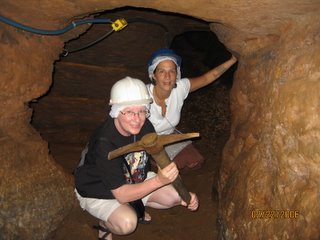
That's Pat, my traveling companion. It has been funny trying to describe Pat's relationship to my family as we traveled: "She's my mother's ex-partner and one of my daughter's grandmothers but no, she isn't a mother to me, more like an aunt or a very very dear friend, something for which we have no word in English and no word in Portuguese."
Driving the main road from Rio de Janeiro to Belo Horizonte - kind of like going from Chicago to Indianapolis or from Los Angeles to San Franciso - there is one road. Much of the time it is a two lane road. People bike on it, a few horses graze along it, grass grows on some of its edges.
Carnaval, it's insane and I love it. We've taken Luca to quite a few kid's parties. I swear, she's going to be the first gringa child to actually samba. I wish for her flexible hips. Last night at the last party of the season - not that Carnaval is over but it's our last party - I had a deeper understanding of this Brazilian approach to pleasure and joy. Imagine a room full of screaming children who are dumping confetti and streamers on top of each other, throwing it in the air, throwing it on top of adults, dancing to traditional samba songs (including one lovely samba original about a dyke - sapatao ), following the adult group leader as he and she thrust and wiggled their hips and waved their butts singing about being sexy, everyone with great big grins on their faces. I love that here, when women are dancing mostly naked and body painted, they don't do that pouting "I'm so sexy" look that women in the States do. Instead, it's with an ear to ear grin. Lovely. Pleasure. Fun.
Taking Pat to Porcao (that's Big Pig) for an experience of Brazilian culinary excess.
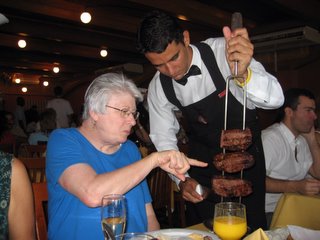
I apologize to all those I love who are vegetarian or vegan. Pat was very happy.
While we were in Minas Gerais, in Ouro Preto to be exact, we went on the tour of a mine that closed down with the ending of slavery in 1888. Not a modern mine large enough for a cart to go through on tracks, this was a scratched out hole through the granite that depending on short adults and children - all slaves - for its labor. Our guide was 50. His grandmother lived to be 106, she died when he was 16. Do the math. She was 26 when slavery ended - already had 6 children although not yet his father. She carried her liberation card with her on a thin chain around her neck and she demanded to be buried with it. A friend of mine in the States - a little older than me at 45 - had a similar story, although her great-grandmother who was born into slavery and freed while still a baby, died when she was very young. I always forget how often history is really about something that happened yesterday, not only in some misty past.
Our tour was a strange mixture - like most of Brazil. Intense information about how the mine worked - did you know they killed some of the young men who grew too tall to stoop down deeply enough and most slaves died before they were 30 after first going blind and deaf from the sound of the pick ringing against rock and the silicate dust settling in their eyes? See how loud it is when I ping this pick against the side - and a very ringing sound called out that made my head ache - well this is what they worked with and now, this would be a lovely photo opportunity so stand here and hold the pick. Click.

That's Pat, my traveling companion. It has been funny trying to describe Pat's relationship to my family as we traveled: "She's my mother's ex-partner and one of my daughter's grandmothers but no, she isn't a mother to me, more like an aunt or a very very dear friend, something for which we have no word in English and no word in Portuguese."
Driving the main road from Rio de Janeiro to Belo Horizonte - kind of like going from Chicago to Indianapolis or from Los Angeles to San Franciso - there is one road. Much of the time it is a two lane road. People bike on it, a few horses graze along it, grass grows on some of its edges.
Carnaval, it's insane and I love it. We've taken Luca to quite a few kid's parties. I swear, she's going to be the first gringa child to actually samba. I wish for her flexible hips. Last night at the last party of the season - not that Carnaval is over but it's our last party - I had a deeper understanding of this Brazilian approach to pleasure and joy. Imagine a room full of screaming children who are dumping confetti and streamers on top of each other, throwing it in the air, throwing it on top of adults, dancing to traditional samba songs (including one lovely samba original about a dyke - sapatao ), following the adult group leader as he and she thrust and wiggled their hips and waved their butts singing about being sexy, everyone with great big grins on their faces. I love that here, when women are dancing mostly naked and body painted, they don't do that pouting "I'm so sexy" look that women in the States do. Instead, it's with an ear to ear grin. Lovely. Pleasure. Fun.
Taking Pat to Porcao (that's Big Pig) for an experience of Brazilian culinary excess.

I apologize to all those I love who are vegetarian or vegan. Pat was very happy.
Friday, February 17, 2006
A night in the life
It's 10pm here, which means that true cariocas are just taking their showers to get ready for a night out. I'm sitting in Luca's bedroom which is also the computer room. She's asleep on the bed behind me. Rocki is reading in our room. I've just been surfing the net for news about Rio.
We live on the far southern edge of Rio in Recreio, a town that used to be sleepy in a beach kind of way but is now witnessing the burst up of tall condominiums. If you go a few minutes down the road from where we live, you're in true country: hand threshing and horse-drawn wagons. This is what is meant by "developing world," this mix of SUVs and wireless internet in one building while on the corner there is no electricity or indoor toilet.
I went online to find out more about the latest in Rocinha. Rocinha is a favela - read "slum" - that we pass everytime we drive to Rocki's mother's house. It's huge - one of the largest in South America - and like any city, is a mixture of devout families and well entrenched drug lords.
And maybe it's different. After all, Rocinha has been able to close down the city of Rio on a number of occassions, by calling for a general strike. And the cabs stopped running and the stores were closed. They are not without power.
And in this city within a city, for the last few days there has been the full battle of a civil war. Drug lords in Rocinha fighting against drug lords in three other favelas.
Here is why I was looking online for more information. Here is what is so strange. I ride the buses here, I drive around with my family, I walk on some streets and I never see any of this. I have gone to Rocinha. I took Luca on a tour, called gaggingly enough "Exotic Tours" but a program in which Rocinha kids get job skills in tourism. I wanted to climb up the streets, to demystify this place that claims so many headlines. I knew that I would see the good Rocinha, the land of families and genuine people, because of course they are there, too. And like south central and the neighborhood in Cleveland where I spent part of my childhood, they don't get the press ink. And so I took Luca and we did the tour. And everyone loved that I brought my child and we got lots of attention and people were lovely and the streets felt sturdy and planted.
Boom crash fourteen dead and the military police have occupied the neighborhood where we were wandering. And I never see any of this and I don't want to see any of this and the older I get, the more used to privilege I get, but this is just too strange.
Even stranger, they are building a temple to the Rolling Stones on Copacabana Beach. This will be the largest Stones show in history and the city is giving it completely free "to the people." They are building a stage, there will be eight large screens to flash the show to the millions they expect to gather. They have built a walkway from Copacabana Palace and over the street to the stage for the VIPs. They are spending millions.
And they are cleaning up the city to make it beautiful. The Stones arrived today. They are waiting in town.
Is there any connection between Rocinha and the Stones or is it just the day's pattern?
We live on the far southern edge of Rio in Recreio, a town that used to be sleepy in a beach kind of way but is now witnessing the burst up of tall condominiums. If you go a few minutes down the road from where we live, you're in true country: hand threshing and horse-drawn wagons. This is what is meant by "developing world," this mix of SUVs and wireless internet in one building while on the corner there is no electricity or indoor toilet.
I went online to find out more about the latest in Rocinha. Rocinha is a favela - read "slum" - that we pass everytime we drive to Rocki's mother's house. It's huge - one of the largest in South America - and like any city, is a mixture of devout families and well entrenched drug lords.
And maybe it's different. After all, Rocinha has been able to close down the city of Rio on a number of occassions, by calling for a general strike. And the cabs stopped running and the stores were closed. They are not without power.
And in this city within a city, for the last few days there has been the full battle of a civil war. Drug lords in Rocinha fighting against drug lords in three other favelas.
Here is why I was looking online for more information. Here is what is so strange. I ride the buses here, I drive around with my family, I walk on some streets and I never see any of this. I have gone to Rocinha. I took Luca on a tour, called gaggingly enough "Exotic Tours" but a program in which Rocinha kids get job skills in tourism. I wanted to climb up the streets, to demystify this place that claims so many headlines. I knew that I would see the good Rocinha, the land of families and genuine people, because of course they are there, too. And like south central and the neighborhood in Cleveland where I spent part of my childhood, they don't get the press ink. And so I took Luca and we did the tour. And everyone loved that I brought my child and we got lots of attention and people were lovely and the streets felt sturdy and planted.
Boom crash fourteen dead and the military police have occupied the neighborhood where we were wandering. And I never see any of this and I don't want to see any of this and the older I get, the more used to privilege I get, but this is just too strange.
Even stranger, they are building a temple to the Rolling Stones on Copacabana Beach. This will be the largest Stones show in history and the city is giving it completely free "to the people." They are building a stage, there will be eight large screens to flash the show to the millions they expect to gather. They have built a walkway from Copacabana Palace and over the street to the stage for the VIPs. They are spending millions.
And they are cleaning up the city to make it beautiful. The Stones arrived today. They are waiting in town.
Is there any connection between Rocinha and the Stones or is it just the day's pattern?
Thursday, February 16, 2006
And my social security number is...
Ok, so I'm slow on the uptake with a lot of things. Usually they fall in the category of "the new paint color on your walls," "that change in the style of your glasses," and other visually subtle differences. Anything that has the faintest whiff of possible conspiracy, well I'm usually there pretty quickly.
So what took me so long to realize that I am probably the only blogger in a universe of bloggers who uses her real name for her profile and webpage? Everyone else seems to choose anonymity.
With no direspect to the Patriot Act, I hate these protect-my-privacy times. I am the kind of person who usually tells you how much I make, who I voted for, and what sort of sex I'm most interested in having. The US is too focused on protecting and extending the hyper-individualism that has isolated us fairly profoundly from each other. As a queer woman in a state that only very recently reversed the laws against sodomy (yes, I do), I can appreciate the importance of protecting privacy. I believe in protecting privacy. But within the context of the current United States of "this is mine, not yours", I don't believe it's the ideal starting point. Particularly when we no longer have a public to weigh against the private.
You can not stand on a street corner and orate about war, the new Wal Mart around the corner, the birth of your new child or Jesus Christ unless you have the necessary permit and, in many places, there are no permits available. The largest "public space" in Minneapolis, where I live, is sadly the Mall of America. In the frozen winter, the majority of Twin Cities residents spend some amount of time visiting this place where you can leave our jacket in the car. If you have small children but hate to shop - again, yes, me - you go just so your kids can run and get some energy off when it's too cold to be outside. But the mall is private space - as are all malls and increasingly parks, streets in front of any business, and so on. I can go there with my child so that she can get some exercize but I can't open my mouth about public education (I still believe in it), health care, the war in Iraq, or how silly the store is that only sells refrigerator magnets.
Those places that are public - parks, wilderness areas, etc - are usually places where individuals go to commune (individually) with nature or to strengthen their individual bodies with exercize. Other places - halls of government, etc - well, you can go and schedule your token protest, make sure the building has enough security to protect your safety, and take your litter with you when you leave.
I didn't buy my first car until I was 31 and the first time I got into that car, I burst into tears. Ok, for those of you who know me, as my partner says, I cry like I sweat. But still, I was "havin' a feelin'". I cried when I got into that car because after 31 years of public transportation and foot traffic, this symbol of my growing privilege gave me way too much control. I could get quickly and easily between two places, stay warm in winter, and have a complex agenda for the day with all of my crap in the back seat, but I was alone. Before, my day and life were unwillingly affected by the people who sat next to me or walked up to me outside. Their days, views, lives, and body odor affected mine. Half the time, this was neutral. A fourth of the time it was a pain in the ass but a fourth of the time it was positive - I became more than I had been before meeting this person. And I knew people, had learned of their lives in bits and pieces of bus rides and street walks, people who did not otherwise connect with my world in any way, shape or form.
Now, public space or "the right to be infringed on" is described as a mark of poverty. And it's true - the only folks who inhabit public space with all of its warts and without the ability to change tend to be folks who have no access to private space - a car, a home, an i-pod. My family uses one car in a city that was not built for walking - so we bike and bus to make up the difference, But these days it's choice. And that's an entirely different thing. There are too many times when I am lazy and pick up my option for easy.
I'll care more about protecting my privacy from internet terrors (I don't have credit cards for them to abuse, only a checking account and a cash card at my credit union and they call me when anything wierd happens on my account) and protecting my identity and protecting my privacy, when there's a public that is accountable to each other. When there is a public that exists more than on the fringes of our lives, that is not the realm of those with few resources, and one in which there is space for that dance between anarchy and democracy which has the potential of getting us somewhere.
Want to know how to find me, where I live - just give it a google.
So what took me so long to realize that I am probably the only blogger in a universe of bloggers who uses her real name for her profile and webpage? Everyone else seems to choose anonymity.
With no direspect to the Patriot Act, I hate these protect-my-privacy times. I am the kind of person who usually tells you how much I make, who I voted for, and what sort of sex I'm most interested in having. The US is too focused on protecting and extending the hyper-individualism that has isolated us fairly profoundly from each other. As a queer woman in a state that only very recently reversed the laws against sodomy (yes, I do), I can appreciate the importance of protecting privacy. I believe in protecting privacy. But within the context of the current United States of "this is mine, not yours", I don't believe it's the ideal starting point. Particularly when we no longer have a public to weigh against the private.
You can not stand on a street corner and orate about war, the new Wal Mart around the corner, the birth of your new child or Jesus Christ unless you have the necessary permit and, in many places, there are no permits available. The largest "public space" in Minneapolis, where I live, is sadly the Mall of America. In the frozen winter, the majority of Twin Cities residents spend some amount of time visiting this place where you can leave our jacket in the car. If you have small children but hate to shop - again, yes, me - you go just so your kids can run and get some energy off when it's too cold to be outside. But the mall is private space - as are all malls and increasingly parks, streets in front of any business, and so on. I can go there with my child so that she can get some exercize but I can't open my mouth about public education (I still believe in it), health care, the war in Iraq, or how silly the store is that only sells refrigerator magnets.
Those places that are public - parks, wilderness areas, etc - are usually places where individuals go to commune (individually) with nature or to strengthen their individual bodies with exercize. Other places - halls of government, etc - well, you can go and schedule your token protest, make sure the building has enough security to protect your safety, and take your litter with you when you leave.
I didn't buy my first car until I was 31 and the first time I got into that car, I burst into tears. Ok, for those of you who know me, as my partner says, I cry like I sweat. But still, I was "havin' a feelin'". I cried when I got into that car because after 31 years of public transportation and foot traffic, this symbol of my growing privilege gave me way too much control. I could get quickly and easily between two places, stay warm in winter, and have a complex agenda for the day with all of my crap in the back seat, but I was alone. Before, my day and life were unwillingly affected by the people who sat next to me or walked up to me outside. Their days, views, lives, and body odor affected mine. Half the time, this was neutral. A fourth of the time it was a pain in the ass but a fourth of the time it was positive - I became more than I had been before meeting this person. And I knew people, had learned of their lives in bits and pieces of bus rides and street walks, people who did not otherwise connect with my world in any way, shape or form.
Now, public space or "the right to be infringed on" is described as a mark of poverty. And it's true - the only folks who inhabit public space with all of its warts and without the ability to change tend to be folks who have no access to private space - a car, a home, an i-pod. My family uses one car in a city that was not built for walking - so we bike and bus to make up the difference, But these days it's choice. And that's an entirely different thing. There are too many times when I am lazy and pick up my option for easy.
I'll care more about protecting my privacy from internet terrors (I don't have credit cards for them to abuse, only a checking account and a cash card at my credit union and they call me when anything wierd happens on my account) and protecting my identity and protecting my privacy, when there's a public that is accountable to each other. When there is a public that exists more than on the fringes of our lives, that is not the realm of those with few resources, and one in which there is space for that dance between anarchy and democracy which has the potential of getting us somewhere.
Want to know how to find me, where I live - just give it a google.
Wednesday, February 15, 2006
This one's for Luisa
I walked into Zona Sul, purposefully and with head held high, meandered to the back of the store and there I met its baleful stare. That big red sea bass - peixe vermelha - was going to be mine tonight and not in any wimpy American way - prefilleted and wrapped in plastic before bringing it home. No, I was going to buy it the honest Brazilian way - barely after its last breath with its eyes only just filming up.
What the hell, I decide to do it the middle class Brazilian way: "Pode limpar essa para mim?" Of course the guy behind the counter could clean it, that's why he was covered in rubber and plastic and sparkled with fish scales. "Enteiro o de costas?" he asked. Ok, he got me. I know what those words mean literally - "Entire or of/from/be (I hate prepositions) the back" but what does that mean? If you're like me and learning a second language, you overthink things. While my first thought was "Oh, entire means keep the fish in one whole fish and not cut in pieces and of the back means cut along the back and split." But then I thought further, maybe it means "entirely done or just done along the back" oh shit, maybe he's saying to me, "do you want me to do it with my entire body or just use the muscles of my back?"
I could have smiled at him, batted my gringa eyelashes, and admitted to being the naive foreigner. I could have smiled and asked him to explain, but he had looked annoyed when I asked him to clean the bloody red thing and now he was just standing there, spiritually tapping his foot and waiting for my reply.
"De costas," I said first, smiling and acting all sure of myself. "Nao, espara, enteiro." I said, changing my mind.
He went in the back room, although I could see him through the glass, and pulled out this mother of a long knife and then another one and then a third. Goodness, Susan, don't try this at home.
And then he bent over and I could see him no more. So I wandered off to pick up a pineapple, some limes, some sweet corn, and a few other bits and bobs, checking every few minutes to see what he was up to. Finally, I saw his head pop up, walked over and then heard the plastic roll going round and round and round and with each rotation, the chunk of a big ass fish hitting the chopper block.
And he gave it to me. And it was a whole fish. And it was still staring at me.
And I brought it home and while Rocki went to pick up Luca from school, I ran to the kitchen and got out my knives. "Have you ever cut a whole fish before?" she had asked and I had nonchalantly replied, "Sure but years ago" which translates to once I helped someone else while I was in college. Come on, I grew up in Cleveland, Ohio. Fish to me meant Mrs. Paul's Fish Sticks. My partner was not going to watch what happened when me and the peixe vermelha got friendly.
Of course, before Rocki left, I was on the internet googling "filleting fish" and "how to clean a sea bass" and they all called for special filleting knives and who knows what else so I decided to just wing it.
Even as we speak, I have two highly uneven and very scraggly looking peixe vermelha fillets baking in the oven, covered gently and lovingly with olive oil, sea salt, lime juice and garlic. Luca loves fish. So do I. My Brazilian lover hates it. She's having leftover pasta tonight.
Tenho saudades, Luisa.
What the hell, I decide to do it the middle class Brazilian way: "Pode limpar essa para mim?" Of course the guy behind the counter could clean it, that's why he was covered in rubber and plastic and sparkled with fish scales. "Enteiro o de costas?" he asked. Ok, he got me. I know what those words mean literally - "Entire or of/from/be (I hate prepositions) the back" but what does that mean? If you're like me and learning a second language, you overthink things. While my first thought was "Oh, entire means keep the fish in one whole fish and not cut in pieces and of the back means cut along the back and split." But then I thought further, maybe it means "entirely done or just done along the back" oh shit, maybe he's saying to me, "do you want me to do it with my entire body or just use the muscles of my back?"
I could have smiled at him, batted my gringa eyelashes, and admitted to being the naive foreigner. I could have smiled and asked him to explain, but he had looked annoyed when I asked him to clean the bloody red thing and now he was just standing there, spiritually tapping his foot and waiting for my reply.
"De costas," I said first, smiling and acting all sure of myself. "Nao, espara, enteiro." I said, changing my mind.
He went in the back room, although I could see him through the glass, and pulled out this mother of a long knife and then another one and then a third. Goodness, Susan, don't try this at home.
And then he bent over and I could see him no more. So I wandered off to pick up a pineapple, some limes, some sweet corn, and a few other bits and bobs, checking every few minutes to see what he was up to. Finally, I saw his head pop up, walked over and then heard the plastic roll going round and round and round and with each rotation, the chunk of a big ass fish hitting the chopper block.
And he gave it to me. And it was a whole fish. And it was still staring at me.
And I brought it home and while Rocki went to pick up Luca from school, I ran to the kitchen and got out my knives. "Have you ever cut a whole fish before?" she had asked and I had nonchalantly replied, "Sure but years ago" which translates to once I helped someone else while I was in college. Come on, I grew up in Cleveland, Ohio. Fish to me meant Mrs. Paul's Fish Sticks. My partner was not going to watch what happened when me and the peixe vermelha got friendly.
Of course, before Rocki left, I was on the internet googling "filleting fish" and "how to clean a sea bass" and they all called for special filleting knives and who knows what else so I decided to just wing it.
Even as we speak, I have two highly uneven and very scraggly looking peixe vermelha fillets baking in the oven, covered gently and lovingly with olive oil, sea salt, lime juice and garlic. Luca loves fish. So do I. My Brazilian lover hates it. She's having leftover pasta tonight.
Tenho saudades, Luisa.
Monday, February 13, 2006
What a woman carries inside
When I walk into a pharmacy in Brazil, move through the aisles past the beauty creams and pampers, I come upon the same thing time and time again: twenty to thirty different packages of sanitary pads and maybe, if I'm lucky, one very expensive kind of imported tampons. Why do women in Brazil not wear tampons?
I've asked a lot of women here already but no one has an answer for me. There are pads for all sizes and flows, brands I recognize from the United States and brands that are home spun or grown or synthesized. But usually only a few OBs or the occassional Tampax for catching the flow further upstream.
This really makes no sense to me. It is hot here. Very hot. And more women on average wear clothes that are either cut tight or cut short or barely there. Skimpy for sweat support. Living in Rio means living near an ocean. Swimming pools are in abundunce and on the weekends, you can barely find space for another body whether on the sand or poolside. And bikinis here, well, the majority are made from dental floss and cotton balls.
Where do they hide the pads?
When I was a tadpole, tampons were just moving from those things that liberated sexual women wore to those things that every woman who didn't want to feel like she was wearing diapers could now choose. This was before toxic shock when fear struck deep into the national vagina. No, television and magazines had pictures of thin thin white women with tight white clothes bending over to pick up golf balls from the green. Look! No bulky pad! No embarrassing red spots in the crotch line!!
I embraced my tampon self, except for the period in my 20s when I opted for natural sea sponges. I still prefer them, but I got tired of going into public toilets and walking through the doors with a bloody red mound in my hand, wringing and rinsing in the sink along with my unwilling sisters, and then going back into my stall to reinsert. For most of my life, I've been a tampon kind of girl.
Have I been misled? Is there something that women here know that I don't know? Has marketing gone so deeply to my brain that I don't realize that even with dioxin-free Nature's Choice tampons, I am still causing some profound bodily harm?
A month or so ago, I asked a woman who was sitting and sweating next to the pool - and wearing shorts which she never does - why she didn't get in the cool refreshing water. It's lovely, I told her, and the sun is so hot. She glanced left and right and then leaned in to explain that she was mensturating (I don't know the slang in Portuguese, I only know menstruating which might sound normal to a Brazilian ear but always sounds Victorian to mine). She couldn't go in to the pool - "get myself wet" was actually what she said - until she was finished.
There I sat, on the steps leading in to the pool, my vagina safely submerged with a tampon tucked carefully away inside, and I wondered if she could see those small microbes of blood that, along with my other womanly juices, must be slipping from the sodden white cotton and delicately polluting the pool.
I never drip, I never stain. And I stay swimming, even when my uterus is cramping up to beat the band. If anything, water pressure like orgasm can really help a girl get through her monthlies.
Why don't women in Brazil use tampons?
And no, don't blame it on Catholicism. You should see the bottle dance. They can aim their girl-bits over the lip of a bottle - from three year old children to happy grandmotherly types - and writhe along with the rest of the family. How come they can't soak up the love with a bit of white cotton?
I've asked a lot of women here already but no one has an answer for me. There are pads for all sizes and flows, brands I recognize from the United States and brands that are home spun or grown or synthesized. But usually only a few OBs or the occassional Tampax for catching the flow further upstream.
This really makes no sense to me. It is hot here. Very hot. And more women on average wear clothes that are either cut tight or cut short or barely there. Skimpy for sweat support. Living in Rio means living near an ocean. Swimming pools are in abundunce and on the weekends, you can barely find space for another body whether on the sand or poolside. And bikinis here, well, the majority are made from dental floss and cotton balls.
Where do they hide the pads?
When I was a tadpole, tampons were just moving from those things that liberated sexual women wore to those things that every woman who didn't want to feel like she was wearing diapers could now choose. This was before toxic shock when fear struck deep into the national vagina. No, television and magazines had pictures of thin thin white women with tight white clothes bending over to pick up golf balls from the green. Look! No bulky pad! No embarrassing red spots in the crotch line!!
I embraced my tampon self, except for the period in my 20s when I opted for natural sea sponges. I still prefer them, but I got tired of going into public toilets and walking through the doors with a bloody red mound in my hand, wringing and rinsing in the sink along with my unwilling sisters, and then going back into my stall to reinsert. For most of my life, I've been a tampon kind of girl.
Have I been misled? Is there something that women here know that I don't know? Has marketing gone so deeply to my brain that I don't realize that even with dioxin-free Nature's Choice tampons, I am still causing some profound bodily harm?
A month or so ago, I asked a woman who was sitting and sweating next to the pool - and wearing shorts which she never does - why she didn't get in the cool refreshing water. It's lovely, I told her, and the sun is so hot. She glanced left and right and then leaned in to explain that she was mensturating (I don't know the slang in Portuguese, I only know menstruating which might sound normal to a Brazilian ear but always sounds Victorian to mine). She couldn't go in to the pool - "get myself wet" was actually what she said - until she was finished.
There I sat, on the steps leading in to the pool, my vagina safely submerged with a tampon tucked carefully away inside, and I wondered if she could see those small microbes of blood that, along with my other womanly juices, must be slipping from the sodden white cotton and delicately polluting the pool.
I never drip, I never stain. And I stay swimming, even when my uterus is cramping up to beat the band. If anything, water pressure like orgasm can really help a girl get through her monthlies.
Why don't women in Brazil use tampons?
And no, don't blame it on Catholicism. You should see the bottle dance. They can aim their girl-bits over the lip of a bottle - from three year old children to happy grandmotherly types - and writhe along with the rest of the family. How come they can't soak up the love with a bit of white cotton?
good will hunting
So, there we were, sitting at the grandmother´s house last night, watching bad cable and cuddling on the couch. After watching The Day After Tomorrow - that classic end of the world tale complete with NYC under a newly forming glacier - we shut off the tube to go to bed. Quickly checking email - it´s an addiction that is even more pronounced here in Brazil where we are constantly searching for notes from friends - I saw a CNN Breaking News announcement. Dick Cheney accidently shoots and injures companion in hunting accident.
Thank you, God. In some very strange way, that little bit of electronic information just shone like a beacon on my screen.
Why? Is it that real life finally - for a brief moment - mirrors real life? And that the man who seems to have no emotion, no depth, nothing other than a propensity for ending up in the right contract at the right time, well, he showed his fumble fingeredness.
And shooting quail? So genteel, so effete, so silly.
I´m glad his friend is fine - only so much as I wouldn´t wish ill on another - but to have a face and chest full of buckshot, a gift from the man who has filled all of our faces and chests with something closer to nuclear, well, there is poetry here.
Thank you, God. In some very strange way, that little bit of electronic information just shone like a beacon on my screen.
Why? Is it that real life finally - for a brief moment - mirrors real life? And that the man who seems to have no emotion, no depth, nothing other than a propensity for ending up in the right contract at the right time, well, he showed his fumble fingeredness.
And shooting quail? So genteel, so effete, so silly.
I´m glad his friend is fine - only so much as I wouldn´t wish ill on another - but to have a face and chest full of buckshot, a gift from the man who has filled all of our faces and chests with something closer to nuclear, well, there is poetry here.
Friday, February 10, 2006
Body memory
Grief is such a strange thing. This skin-wringing emotion that pulls you out - toe end to scalp - and literally empties you. Then you rest. Then some time later, after gathering in pools you can't see, it wrings you out again.
Grief makes me believe or understand or more importantly FEEL that time is not linear. Instead, it's a woven thing. Today, we went to see Walking the Line. Yep, we're in Rio without having to work too many hours, Luca is in school in the afternoons, so I am determined to see all of the Academy Award nominated films this year. Why not? We all need goals.
Anyhow, today we saw Walking the Line. I knew nothing about Johnny Cash and June Carter Cash before seeing this film (I know, I still might not know anything, but I imagine that I do). In high school I had the album "Live at Folsom Prison" and listened to it until it was worn transluscent but I didn't pay much attention to the life of the singer. The early part of the film deals primarily with J.C's relationship with his older brother, Jack. When he was 12 or 13, Jack died horribly and suddenly in a buzzsaw accident. His father was a drinker, had no emotional skills, Johnny felt guilty his whole life, bla bla bla, that part isn't that important. Right after Jack dies, there is a scene with the young Johnny in bed and crying, "Jack, please don't leave me alone." And that was it. Wham-o, right in the kisser.
Warp and weave and time twisted and I was missing my brother horribly. My brother, PJ, died when he was five and I was seven. We were both in a car accident - our whole family was in a car accident, but that's for another blog - and PJ and I were thrown into a river, I tried to pull him out but couldn't (I think he was already dead as his eyes were closed but will never be sure), he drowned.
I don't usually miss PJ. I most often miss my father - he died at the same accident. But this afternoon, I could FEEL PJ. My body knew him. My arms could feel the soft of his pyjamas when I was hugging him, I could smell his hair. It felt that real, something that happened 35 years ago felt that absurdly completely real. As real as Rocki holding my hand, as the sharp edges of the balled up popcorn bag in my other hand. And the grief that came along with the memory - is it as strong as grief so many years ago? I don't know, these things don't compare - but I cried in that bone way.
I think this is some of my current obsession with trying to understand the biochemical piece of emotion. I believe in bodymemory. When neuroscience now says that you don't "think" with your brain, you think with a cognitive system that includes your brain, your lymph system, your glands and that these are connected to every cell in your body. That your cells can and do have memory and your cognition system's role is to turn that memory (color, sound, smell, touch, pacing) into a narrative that you then "understand": well, it makes me breathe easier. Rocki keeps asking me why I put so much stock in science, when all along I "knew" this was true in that I perceived it to be so. Suddenly, though, "science" puts the great big check mark on what I have already felt and I breathe comfortably. It's like, the books I am reading give me a map and a language, one where I can say, "oh, yes, I've visited here before, Didn't know the history or why the buildings were built the way they were, but I've certainly seen it." It fleshes things out - pun intended.
I am reading books on neurochemistry and the cognition system, the history of storytelling and the history of myth, a wee bit of highly pedestrian quantum physics, rereading Hannah Arendt's work on totalitarianism, and somewhere in all of this, there is something I am supposed to understand. Karen Armstrong - one of my favorite authors, she's a religious historian - was once asked after all of her work on the three primary monotheistic belief systems, which one does she feel the most connected to. She neatly sidestepped the question by replying that she has become more herself - spiritually, intellectually, emotionally - through gifts she has received from all. Then she said that the gift she gained from Judaism was to have a deeper understanding of what it means to be a "People of the Book." "When I am lost," she said, "I start to read and I read and I read and I read and in the middle of all of that reading, I make lots of time for silence. Sometimes, in the midst of all of this, there is a light that comes, an understanding that goes far deeper than understanding, than anything of the intellect, and at that moment, I feel God."
I'm just trying to understand something - and missing my brother today - well, it's all in the same territory.
Grief makes me believe or understand or more importantly FEEL that time is not linear. Instead, it's a woven thing. Today, we went to see Walking the Line. Yep, we're in Rio without having to work too many hours, Luca is in school in the afternoons, so I am determined to see all of the Academy Award nominated films this year. Why not? We all need goals.
Anyhow, today we saw Walking the Line. I knew nothing about Johnny Cash and June Carter Cash before seeing this film (I know, I still might not know anything, but I imagine that I do). In high school I had the album "Live at Folsom Prison" and listened to it until it was worn transluscent but I didn't pay much attention to the life of the singer. The early part of the film deals primarily with J.C's relationship with his older brother, Jack. When he was 12 or 13, Jack died horribly and suddenly in a buzzsaw accident. His father was a drinker, had no emotional skills, Johnny felt guilty his whole life, bla bla bla, that part isn't that important. Right after Jack dies, there is a scene with the young Johnny in bed and crying, "Jack, please don't leave me alone." And that was it. Wham-o, right in the kisser.
Warp and weave and time twisted and I was missing my brother horribly. My brother, PJ, died when he was five and I was seven. We were both in a car accident - our whole family was in a car accident, but that's for another blog - and PJ and I were thrown into a river, I tried to pull him out but couldn't (I think he was already dead as his eyes were closed but will never be sure), he drowned.
I don't usually miss PJ. I most often miss my father - he died at the same accident. But this afternoon, I could FEEL PJ. My body knew him. My arms could feel the soft of his pyjamas when I was hugging him, I could smell his hair. It felt that real, something that happened 35 years ago felt that absurdly completely real. As real as Rocki holding my hand, as the sharp edges of the balled up popcorn bag in my other hand. And the grief that came along with the memory - is it as strong as grief so many years ago? I don't know, these things don't compare - but I cried in that bone way.
I think this is some of my current obsession with trying to understand the biochemical piece of emotion. I believe in bodymemory. When neuroscience now says that you don't "think" with your brain, you think with a cognitive system that includes your brain, your lymph system, your glands and that these are connected to every cell in your body. That your cells can and do have memory and your cognition system's role is to turn that memory (color, sound, smell, touch, pacing) into a narrative that you then "understand": well, it makes me breathe easier. Rocki keeps asking me why I put so much stock in science, when all along I "knew" this was true in that I perceived it to be so. Suddenly, though, "science" puts the great big check mark on what I have already felt and I breathe comfortably. It's like, the books I am reading give me a map and a language, one where I can say, "oh, yes, I've visited here before, Didn't know the history or why the buildings were built the way they were, but I've certainly seen it." It fleshes things out - pun intended.
I am reading books on neurochemistry and the cognition system, the history of storytelling and the history of myth, a wee bit of highly pedestrian quantum physics, rereading Hannah Arendt's work on totalitarianism, and somewhere in all of this, there is something I am supposed to understand. Karen Armstrong - one of my favorite authors, she's a religious historian - was once asked after all of her work on the three primary monotheistic belief systems, which one does she feel the most connected to. She neatly sidestepped the question by replying that she has become more herself - spiritually, intellectually, emotionally - through gifts she has received from all. Then she said that the gift she gained from Judaism was to have a deeper understanding of what it means to be a "People of the Book." "When I am lost," she said, "I start to read and I read and I read and I read and in the middle of all of that reading, I make lots of time for silence. Sometimes, in the midst of all of this, there is a light that comes, an understanding that goes far deeper than understanding, than anything of the intellect, and at that moment, I feel God."
I'm just trying to understand something - and missing my brother today - well, it's all in the same territory.
O Dia Abufado
I am tired of people apologizing to me because they don't speak English. I am living in Brazil, the language here is Portuguese, not English. And yet I am constantly running into people who feel badly - inept, even - because they don't speak English.
As one friend pointed out, you have no hope of really advancing to any meaningful level in any kind of career or work place without speaking English. Look, said another friend, you need English to understand half of the signs on shops these days, or to understand most of the gadgets in the marketplace.
I know this is true. I know that in the increasingly interdependant global market, global culture, global environment where English - and the United States - reigns most powerful, speaking English is a very good skill to have.
Marco didn't understand when I told him the thousands of English courses on every street corner, the compulsion to speak English, embarrasses me. Even makes me sad. I explained that the reverse is not true in the United States. Quite the opposite. Most folks expect everyone else to speak English and don't bother to learn other languages, unless they have to. He still didn't understand when I explained that I don't like the power differential - we can be lazy, you have to apply yourself to succeed. He mostly laughed and said, but that's just the way it is. You're just lucky that English is the language you learned first.
I get so many strokes from strangers here because I speak any Portuguese at all. "But you're American. No one from the US ever speaks Portuguese," they say. I explain that after ten years of being partnered to a Brazilian, I am ashamed that I don't speak better Portuguese. I should be able to communicate far more than I do. "But you speak some Portuguese, that's amazing." they say, "No one from the US ever speaks Portuguese."
It's true - the more privilege or power that you have, the more that just gathers around your body. It's like a man who gets applauded because he takes his kid to the playground - oh, you're so special, such a good daddy, I wish I had a husband like you - when mommy dearest takes the kid to the playground every other day. Daddy has an unfair advantage in child-rearing (my brother always talks about how annoyed he gets when he gets all of this glowing praise for just loving his son and caring for him) just like English-speaking American has an unfair advantage in the world of multilingualism.
Oh well, lest I ever start believing it when people tell me I'm awesome because I can order coffee in Portuguese, I only have to remember the countless times I've screwed up. Like when we first arrived on this trip and we went to eat in a restaurant. It was a rodizio which means, among other things, the staff walk around with plates of food and you select the things you want to eat. I was getting some spaghetti alho olho. He put some on my plate and I said, "Bastante" which literally means, "enough." So he gave me some more. "Bastante," I said again. He put more on my plate. "Bastante" and then more and back and forth until I was desperate to stop this growing mountain of pasta. Finally I said, "para, por favor," stop please, and he did.
In explaining this to a friend, she started laughing crazily. While "bastante" literally means "enough," you use it here to mean enough like it was a lot and that's a pleasurable thing. Repeating "bastante" to the waiter made him think that I was reveling in my gluttony, wanting a whole mountain of spaghetti, that gobs of food would be enough for me.
I have a long way to go towards fluency.
As one friend pointed out, you have no hope of really advancing to any meaningful level in any kind of career or work place without speaking English. Look, said another friend, you need English to understand half of the signs on shops these days, or to understand most of the gadgets in the marketplace.
I know this is true. I know that in the increasingly interdependant global market, global culture, global environment where English - and the United States - reigns most powerful, speaking English is a very good skill to have.
Marco didn't understand when I told him the thousands of English courses on every street corner, the compulsion to speak English, embarrasses me. Even makes me sad. I explained that the reverse is not true in the United States. Quite the opposite. Most folks expect everyone else to speak English and don't bother to learn other languages, unless they have to. He still didn't understand when I explained that I don't like the power differential - we can be lazy, you have to apply yourself to succeed. He mostly laughed and said, but that's just the way it is. You're just lucky that English is the language you learned first.
I get so many strokes from strangers here because I speak any Portuguese at all. "But you're American. No one from the US ever speaks Portuguese," they say. I explain that after ten years of being partnered to a Brazilian, I am ashamed that I don't speak better Portuguese. I should be able to communicate far more than I do. "But you speak some Portuguese, that's amazing." they say, "No one from the US ever speaks Portuguese."
It's true - the more privilege or power that you have, the more that just gathers around your body. It's like a man who gets applauded because he takes his kid to the playground - oh, you're so special, such a good daddy, I wish I had a husband like you - when mommy dearest takes the kid to the playground every other day. Daddy has an unfair advantage in child-rearing (my brother always talks about how annoyed he gets when he gets all of this glowing praise for just loving his son and caring for him) just like English-speaking American has an unfair advantage in the world of multilingualism.
Oh well, lest I ever start believing it when people tell me I'm awesome because I can order coffee in Portuguese, I only have to remember the countless times I've screwed up. Like when we first arrived on this trip and we went to eat in a restaurant. It was a rodizio which means, among other things, the staff walk around with plates of food and you select the things you want to eat. I was getting some spaghetti alho olho. He put some on my plate and I said, "Bastante" which literally means, "enough." So he gave me some more. "Bastante," I said again. He put more on my plate. "Bastante" and then more and back and forth until I was desperate to stop this growing mountain of pasta. Finally I said, "para, por favor," stop please, and he did.
In explaining this to a friend, she started laughing crazily. While "bastante" literally means "enough," you use it here to mean enough like it was a lot and that's a pleasurable thing. Repeating "bastante" to the waiter made him think that I was reveling in my gluttony, wanting a whole mountain of spaghetti, that gobs of food would be enough for me.
I have a long way to go towards fluency.
Wednesday, February 08, 2006
Who's your daddy?
Yesterday, while browsing through my friend, Vikki's, blog, I saw that someone none of us knew, yes, a stranger, had posted a comment. Suddenly my world shifted. Oh, you mean random people, folks from OUT THERE, might actually read these things. People who don't know Luca, Stella, Miguel, Augie and the host of other small fry that I refer to?
What does that do to this whole blogging thing?
I'm reading a book called Us and Them. It's part of my current obsession: a rash of books on brain chemistry and the neurochemical background to emotion, thought and culture. Us and Them examines how each of us is constantly continually unceasingly responding to our environment by figuring out who is like us - at least at this moment - and who isn't. It describes this not through an analysis of culture and society - my usual path - but through looking at what goes on in your brain in these moments. And how, bottom line, this is something we all do, across culture, across nation, across age.
And then came the blog. After seeing this "post by a stranger," all of us - the Vikki community - went running to see his blog. Who is this interloper? Is he like us? Do we like what he has to say? Because this will, of course, determine whether or not we hold any stock in his comments.
Yes, it's true, if said Empty Man were a rabid right winger crying for the death and destruction of homosekshality (many although not all of Vikki's community are of some form of queer expression), well, his words would be read through that lens. Instead, he was this incredibly thoughtful and creative thinker. So suddenly, his words take on a different slant. Hey Mikey, we like him.
If there's a sign of maturity that I am aspiring to gain, it's the ability to really hear what an individual says for the specificity of that moment and not by hearing said person and looking for clues, hints as to whether or not I am going to agree with the words before I even hear them. The whole left/right thing feels generally more problematic to me, in terms of leading to change that makes sense. There are plenty of closed minded lefties and open minded righties. I guess if I had to pick a closed minded person, I'd pick a leftie any day. But if I'm hoping for real change - something that really exists to discover some kind of functional democracy - then the willingness to think outside of what we currently know seems like a great benefit. Especially since all that we know - left and right - are failed democracies that only privilege whoever is currently in power. And while I would prefer the lefties were in power, once we're in power within this profoundly flawed system, the seconds are ticking until we get too glamoured by the power and then, yes, fuck up.
Left and right rhetoric usually exists within the current system - the system whose linear landscape gave birth to the two directions.
What does that do to this whole blogging thing?
I'm reading a book called Us and Them. It's part of my current obsession: a rash of books on brain chemistry and the neurochemical background to emotion, thought and culture. Us and Them examines how each of us is constantly continually unceasingly responding to our environment by figuring out who is like us - at least at this moment - and who isn't. It describes this not through an analysis of culture and society - my usual path - but through looking at what goes on in your brain in these moments. And how, bottom line, this is something we all do, across culture, across nation, across age.
And then came the blog. After seeing this "post by a stranger," all of us - the Vikki community - went running to see his blog. Who is this interloper? Is he like us? Do we like what he has to say? Because this will, of course, determine whether or not we hold any stock in his comments.
Yes, it's true, if said Empty Man were a rabid right winger crying for the death and destruction of homosekshality (many although not all of Vikki's community are of some form of queer expression), well, his words would be read through that lens. Instead, he was this incredibly thoughtful and creative thinker. So suddenly, his words take on a different slant. Hey Mikey, we like him.
If there's a sign of maturity that I am aspiring to gain, it's the ability to really hear what an individual says for the specificity of that moment and not by hearing said person and looking for clues, hints as to whether or not I am going to agree with the words before I even hear them. The whole left/right thing feels generally more problematic to me, in terms of leading to change that makes sense. There are plenty of closed minded lefties and open minded righties. I guess if I had to pick a closed minded person, I'd pick a leftie any day. But if I'm hoping for real change - something that really exists to discover some kind of functional democracy - then the willingness to think outside of what we currently know seems like a great benefit. Especially since all that we know - left and right - are failed democracies that only privilege whoever is currently in power. And while I would prefer the lefties were in power, once we're in power within this profoundly flawed system, the seconds are ticking until we get too glamoured by the power and then, yes, fuck up.
Left and right rhetoric usually exists within the current system - the system whose linear landscape gave birth to the two directions.
Tuesday, February 07, 2006
An ode to Luca
She's home sickish today. While she was resting, she climbed up on top of my belly to lie - body to body. She loves to do this - she tries to get our heartbeats to go at the same pace or our breathing to follow the same pattern. While she was there, smashed on top of my body, I could feel the length of her. She has grown so much. And every cliche about how quickly they change, about how when these days of long body hugs and simple love are over, you will miss them. And I already do, even before they are gone.
She is changing so much. The first few months here were so hard for her and now, she is a different person. Through the fire and out the other side, she is stronger. That is clear, that she is stronger. Somehow this experience has taken some of those smaller parts of her, those more often afraid parts of her, and teased them out. She is so much clearer about belonging.
I love the days when she is chatty, when she sits down next to me, puts one hand on my knee and says, "Mama, let's have a good conversation, ok?" And then she usually starts right away by asking me about me, "Mama, how are you? How was your day?" She asks me questions, wants to know why I did the things I did, and then when it's her turn, she says things like, "Now, mama, I want you to pay attention because I'm going to tell you some important things." And then she talks. About school. About missing her friends in Minneapolis. About death. About children and babies. About really good orange juice. About anything.
I am most curious to see her when we get home to Minneapolis. Her changes start to feel visible to me here already. What will they look like when they show up against her old environment? How will she be when the real Stella, Georgia, Augie, Miguel, Jasper, Winston, T'Kai are sitting across from her? They all live in her days here so intensely. They are included in her conversations, in her thoughts.
And now she just came in and grabbed me, "Mama, venha rapido. E muito engracado, essa programa. Precisa ver." And so I am going. There is an animal show on that I clearly have to see.
She is changing so much. The first few months here were so hard for her and now, she is a different person. Through the fire and out the other side, she is stronger. That is clear, that she is stronger. Somehow this experience has taken some of those smaller parts of her, those more often afraid parts of her, and teased them out. She is so much clearer about belonging.
I love the days when she is chatty, when she sits down next to me, puts one hand on my knee and says, "Mama, let's have a good conversation, ok?" And then she usually starts right away by asking me about me, "Mama, how are you? How was your day?" She asks me questions, wants to know why I did the things I did, and then when it's her turn, she says things like, "Now, mama, I want you to pay attention because I'm going to tell you some important things." And then she talks. About school. About missing her friends in Minneapolis. About death. About children and babies. About really good orange juice. About anything.
I am most curious to see her when we get home to Minneapolis. Her changes start to feel visible to me here already. What will they look like when they show up against her old environment? How will she be when the real Stella, Georgia, Augie, Miguel, Jasper, Winston, T'Kai are sitting across from her? They all live in her days here so intensely. They are included in her conversations, in her thoughts.
And now she just came in and grabbed me, "Mama, venha rapido. E muito engracado, essa programa. Precisa ver." And so I am going. There is an animal show on that I clearly have to see.
Subscribe to:
Posts (Atom)